Time Without Tense: 5 Surprising Truths About Sranan Tongo
The Republic of Suriname is one of the most multicultural nations on earth, a place forged from the complex histories of Indigenous peoples, European colonizers, enslaved Africans, and indentured laborers arriving from India, Indonesia, and China. From this unique melting pot emerged Sranan Tongo, an English-based creole that serves as the nation’s primary lingua franca—its linguistic glue.
But behind this everyday language lies a story full of surprising twists. It is a language that challenges our fundamental ideas about how grammar works, how languages evolve, and how they reflect the very soul of a people. Here are five surprising truths that reveal the complexity and ingenuity of Sranan Tongo.
1. When “Zero” Means Everything
One of the most mind-bending features of Sranan is its concept of “zero verb marking.” In English, we typically change a verb to show tense, like the difference between walk and walked. In Sranan, many verbs appear in a “zero” form with no marking at all.
This reveals a fascinating cognitive shortcut: the absence of a marker is part of a sophisticated system for conveying time, where the meaning of the zero-marked verb changes depending on the inherent nature of the verb itself.
- A zero-marked stative verb—one that describes a state of being, like
sabi (‘to know’)—refers to the present.
- Ala sma sabi (‘All people know’)
- However, a zero-marked dynamic verb—one describing an action, like go
(‘to go’)—refers to a completed event in the past.
- Mi go tide (‘I went today’)
This feature, which linguists call the “present perfective paradox,” reveals a system where the verb’s core meaning interacts with the “zero” marker to establish a temporal reference. The zero form indicates that the situation, whether a present state or a past action, has a direct connection to the speaker’s “immediate reality”.
2. The Ultimate Multitasker: Kaba
Sranan demonstrates remarkable linguistic efficiency, and no word showcases this better than kaba. This single word performs a huge amount of grammatical work, adapting its meaning based on its position in a sentence.
- As a main verb: It means ‘to finish.’
- Mi no kan kba ala mi moni (‘I can’t finish all my money’)
- As a post-verbal marker: Following a verb, it signals completion and is
best translated as ‘already.’
- Tien joeroe fom kaba (‘Ten o’clock struck already’)
- As a clause-final time adverb: Similar to its post-verbal use, it emphasizes completion or the sense of ‘already’.
- As a clausal connective: It can link clauses, meaning ‘and,’ ‘but,’ or ‘when.’
Historically, kaba is a success story. During the 18th century, its use expanded so much that it eventually pushed out the English-derived word alredi (‘already’). This demonstrates how creole languages often develop powerful, multifunctional words that pack a huge amount of grammatical information into a single, elegant form.
3. A Linguistic Fingerprint: 17th-Century English Villagers
A common misconception is that creole languages are “broken” or simplified versions of their European source languages. This phonetic evidence acts like linguistic DNA, allowing us to trace the precise dialectal origins of Sranan’s English features with remarkable accuracy.
By analyzing features like “post-vocalic rhoticity” (the pronunciation of the ‘r’ sound in words like ‘burn’), researchers have shown that Sranan is not derived from the standardized English of London. The key finding is that Sranan’s features are most similar to a dialect spoken in the village of Blagdon, near the port of Bristol—a major departure point for indentured servants traveling to the Caribbean.
Crucially, the study used data on English dialects collected in the 1950s as a proxy to reconstruct the regional speech patterns of the 17th century. The analysis also reveals a mixture of features from other regions, including Wales and eastern England. This provides concrete evidence that Sranan is not a simplification but a systematic and traceable fusion of specific, regional English dialects.
4. The Language of the Street, The Language of the Heart
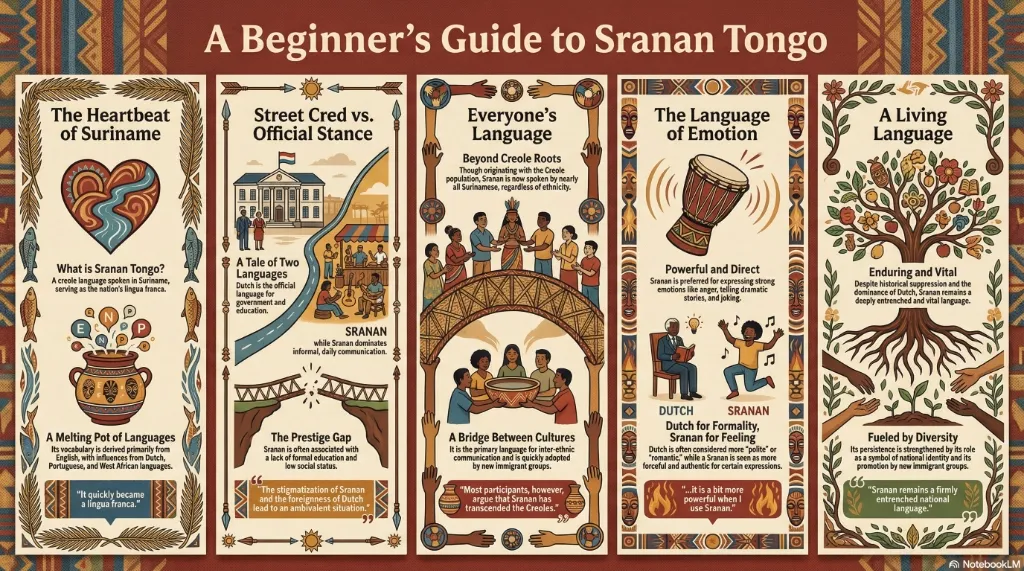
Sranan Tongo exists in a social paradox. On one hand, it has historically held a low social status. Dutch is the official language of government, business, and education in Suriname. In the past, speaking Sranan was forbidden in schools, and it is still sometimes associated with a “lack of education.”
On the other hand, Sranan is the vital, beating heart of the nation. It functions as the primary lingua franca, enabling communication and forging connections between Suriname’s many diverse ethnic groups. When Surinamese students were asked what language best represents their national identity, many chose Sranan over the official Dutch, arguing that Sranan “is spoken by every Surinamese” and is “theirs” in a way Dutch is not.
More importantly, it is the language of emotion and identity. As one student explained:
“That is a bit hard to express my emotions really what emotions? The love emotions eh… than it is a bit more romantic. I cannot do that in Sranan Tongo… but but but revenge feelings or something. I cannot express myself then in Dutch… I do not know, but that there it is a bit more powerful when I use Sranan.”
This reveals that a language’s official “prestige” and its true cultural “value” are two very different things.
5. Secret Tongues: The Logic of Kumanti
The Maroon communities of Suriname are comprised of the descendants of enslaved Africans who escaped the coastal plantations to form independent societies in the remote interior. For centuries, it was believed that their ritual languages, such as Kumanti, were preserved West African languages carried over from their ancestors.
Recent research has revealed a far more fascinating truth: Kumanti is not a direct African retention but an ingeniously engineered mixed language. Linguists identify it as a “symbiotic intertwined language,” meaning it strategically pairs the grammar of one language with the lexicon of another.
Its structure is built on the grammar of Ndyuka—a Maroon creole related to Sranan—which serves as its foundational system. Over this creole base, the creators of Kumanti overlaid a secret lexicon (vocabulary) derived from a variety of sources, including several West African languages, archaic creole words, and other non-Ndyuka terms.
- For instance, where Sranan uses the word bakra for a ‘white man,’ Kumanti uses abrôfô, a word derived from the Twi language of Ghana.
This discovery demonstrates an act of active and brilliant linguistic creation, showing how the Maroons built a new, secret language to safeguard their cultural heritage, rather than simply passively preserving an old one.
A Living History
Sranan Tongo and its related languages are far from simple dialects; they are living archives of Suriname’s history of contact, resistance, and creation. We see this in a grammar that reflects a unique worldview by telling time without tense markers, and in a lexicon where single words like kaba multitask with an efficiency born of necessity.
Its phonetics serve as a fingerprint, tracing its origins back to specific 17th-century English villagers, while its social role as the “language of the heart” stands as a testament to cultural needs triumphing over official policy. Finally, in its secret “offspring” like Kumanti, we witness a profound act of conscious cultural safeguarding.
Sranan is the story of Suriname itself—a story of resilience, creativity, and the enduring power of language to define a people.
Master Any Language with Mytoori
Stop struggling with flashcards and boring lessons. Mytoori helps you learn naturally through immersive storytelling and real-world conversations.
Start Learning Free